TL;DR:
- A mesh with a 20×20 count and openings around 1.04 mm effectively blocks no-see-ums. Standard screens like 16×16 or 18×14 are too coarse, allowing tiny biting insects to pass through. Physical barrier-specific meshes, verified by their opening size, outperform vague “insect-resistant” labels for outdoor protection.
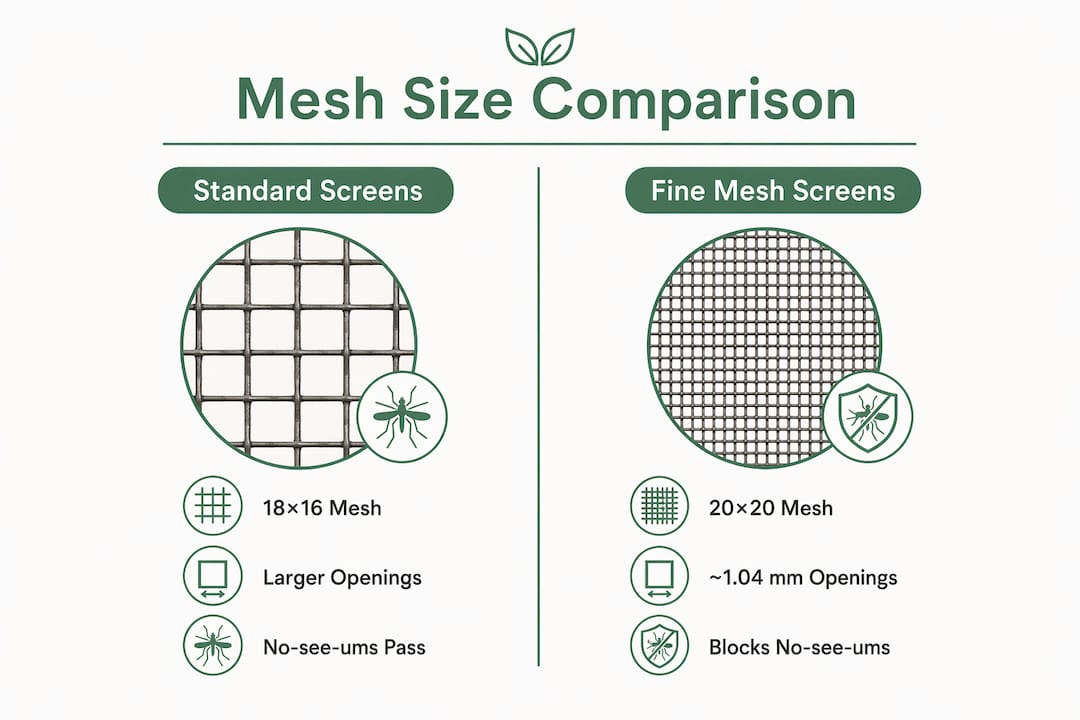
To stop no-see-ums, you need a minimum 20×20 mesh (20 strands per inch in each direction), which produces roughly 400 openings per square inch with individual openings around 0.041 inches (1.04 mm). That’s the spec that physically blocks biting midges. Anything coarser and they walk right through. Bugawaygear’s ultra-fine mesh clothing is built around this same principle: a physical barrier, zero chemicals.
When shopping, skip anything labeled just “insect-resistant.” Look for the explicit mesh count number — 20×20 or finer — or the words “no-see-um” on the label.
Table of Contents
- Why standard screens let no-see-ums through
- How mesh specs actually work — and which number matters most
- What mesh to choose for your specific situation
- How to check whether your existing mesh will actually work
- Keeping fine mesh in good shape
- Bugawaygear’s chemical-free approach to no-see-um protection
- Key Takeaways
- The case for physical barriers over chemical dependency
- Bugawaygear pants: chemical-free protection you wear
- Useful sources
Why standard screens let no-see-ums through
No-see-ums are biting midges, sometimes called sand flies or gnats, and they’re tiny — typically 1–3 mm long, with bodies narrow enough to slip through gaps that stop mosquitoes cold. The problem is that most people assume any bug screen will handle them.
Standard window and tent screens — the 16×16 or 18×14/18×16 weaves you find at every hardware store — produce only around 156 openings per square inch. Those openings are large enough for midges to pass through without touching the wires. Purdue University Extension confirms that standard screens are insufficient against biting midges and that finer screening is required.
Situations where people get burned by this assumption:
- Backpacking tents marketed as “bug-proof” that use standard mesh panels
- Porch and patio enclosures with 18×14 screens installed for mosquito control
- Lightweight head nets sold for general insect use without a stated mesh count
- RV window screens that came factory-installed and were never upgraded
How mesh specs actually work — and which number matters most
Mesh count describes how many strands run per linear inch in each direction. A 20×20 mesh has 20 wires across and 20 down, resulting in many small openings; a 30×30 mesh is even finer with more openings per square inch. The count tells you density; the opening diameter tells you whether a specific insect can fit through.
Here’s a quick reference for the specs that matter:
| Term | What it means |
|---|---|
| Mesh count | Strands per linear inch in each direction (e.g., 20×20) |
| Openings per sq. in. | Mesh count multiplied together (20×20 = 400) |
| Opening diameter | Physical size of each hole — the number that determines insect exclusion |
| Tricot knit | A stretch-knit construction that achieves high hole counts with better flexibility than woven fiberglass |
For no-see-ums, the opening diameter is the number that actually matters. Data from WovenWire shows a 20×20 woven screen has openings of approximately 0.041 inches (1.04 mm), while a 30×30 screen drops to roughly 0.027 inches (0.686 mm). Openings below about 0.85 mm reliably block biting midges.
The mesh count and opening diameter often appear together on product pages. When they conflict — say, a product claims “20×20” but the listed opening is larger than 1.04 mm — trust the opening diameter.
Pro Tip: On product packaging, if only one spec is listed, the opening diameter in mm is more useful than the mesh count alone. A 20×20 woven fiberglass screen and a 20×20 tricot-knit fabric can have meaningfully different actual opening sizes depending on fiber diameter.
What mesh to choose for your specific situation
Protection and breathability pull in opposite directions, but not at the same rate. Going from 18×16 to 20×20 cuts midge entry dramatically with only a modest airflow reduction. Jumping from 20×20 to 30×30 adds near-complete exclusion but noticeably reduces ventilation — worth it in high-infestation coastal or marsh environments, less so on a breezy mountain trail.
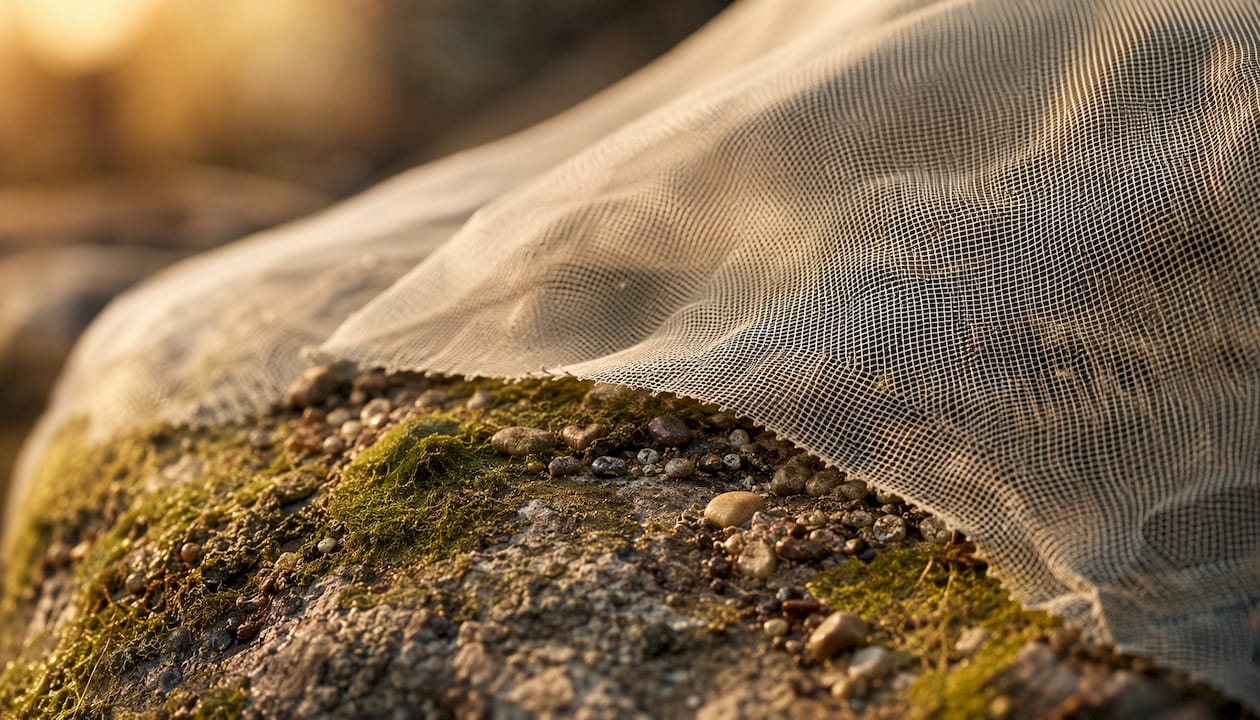
Premium tricot-knit and specialty weaves can have much higher opening counts while maintaining flexibility and breathability better than woven fiberglass. That’s the construction Bugawaygear uses in its clothing line.
| Application | Recommended spec | Trade-off |
|---|---|---|
| Tents and bed nets | 20×20 minimum | Good airflow; handles most environments |
| High-infestation areas (marsh, coast) | 30×30 or finer | Reduced ventilation; near-complete exclusion |
| Window and porch screens | 20×20 (e.g., Phifer No-See-Um) | Slight visibility reduction vs. standard screen |
| Clothing and head nets | Ultra-fine tricot knit or “no-see-um” labeled | Best breathability at high protection levels |
Recommendations by use case:
- Overnight camping: 20×20 tent mesh is typically sufficient for many areas; in regions with high insect infestation, a finer mesh such as 30×30 is advisable.
- Daytime hiking or gardening: Clothing matters more than fixed screens. A tricot-knit garment with an explicit no-see-um spec outperforms any head net with vague “insect-resistant” labeling.
- Home windows and porches: Phifer’s 20×20 No-See-Um screen is a commercially available fiberglass option designed for exactly this use.
Pro Tip: For family outings where kids are running in and out, clothing is more practical than relying on fixed screens. A garment with a verified mesh spec travels with the wearer — a screen doesn’t.
How to check whether your existing mesh will actually work
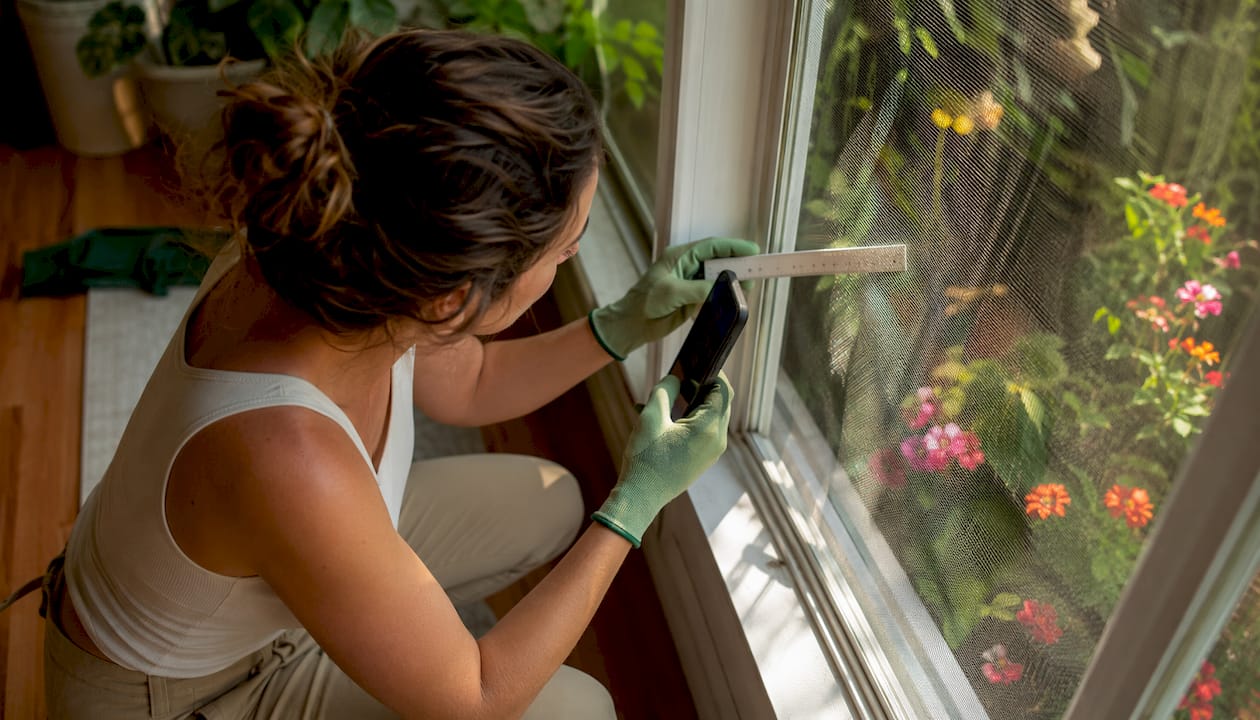
You don’t need a lab. A ruler, your phone camera, and two minutes will tell you whether what you have is up to the job.
- Count the strands. Lay the mesh flat in good light. Place a ruler along one edge. Count how many wires cross one inch in each direction. If you get fewer than 20 in either direction, the mesh won’t stop no-see-ums.
- Use your phone camera. Zoom in on the mesh against a bright background. Count openings across a known distance. This works well for fine fabrics where a ruler alone is hard to read.
- Hold it to light. A 20×20 mesh held to daylight looks noticeably dimmer than an 18×16 screen. If you can see through it easily with large bright squares, it’s too coarse.
- Estimate the opening size. If you counted 20 strands per inch and the wire looks thin, you’re likely near the 1.04 mm opening range. If the wires look thick relative to the gaps, the actual opening may be smaller — which is fine.
- Check for damage. Run a finger lightly across the surface. Any snags, stretched areas, or visible holes larger than the surrounding mesh mean the barrier is compromised at those points.
Tools you need: a ruler, a magnifying glass or phone camera, and a fine marker to mark your counting start point.
If your count comes in below 20×20 or you find physical damage, replacement beats repair for anything you’re relying on for overnight protection.
Keeping fine mesh in good shape
Ultra-fine mesh — whether woven fiberglass or tricot-knit fabric — degrades faster than standard screening when handled roughly. A few habits extend its life significantly.
- Wash gently. Hand wash or use a delicate machine cycle with mild detergent. Avoid stiff brushes; they abrade fibers and enlarge openings over time.
- Air dry only. Heat from a dryer can distort woven fiberglass and weaken tricot-knit fibers. Lay flat or hang loosely.
- Patch small holes promptly. A pinhole in tent mesh becomes a midge highway. Mesh repair tape designed for tent fabric handles small punctures well; larger tears usually warrant panel replacement.
- Store carefully. Don’t fold mesh clothing tightly along the same crease repeatedly — stress concentrates at fold lines and eventually causes micro-tears.
- Avoid contact with rough surfaces. Dragging a mesh garment across bark or a rough pack surface is the fastest way to create the kind of abrasion damage that’s invisible until insects find it.
Pro Tip: Store mesh clothing rolled loosely inside a breathable mesh bag rather than compressed flat. It takes up slightly more space but eliminates the crease-stress that shortens garment life.
Bugawaygear’s chemical-free approach to no-see-um protection
Bugawaygear’s pants and jackets use ultra-fine mesh construction to create a physical barrier against biting insects — no insecticides, no permethrin treatment, no sprays. The mesh spec is built into the garment, so protection doesn’t wash out or degrade with repeated laundering the way chemical treatments do.
The brand’s proof points are straightforward: 100% chemical-free materials, a 30-day money-back guarantee, and reports from over 500 customers who experienced zero tick bites while wearing their products.
For hikers and gardeners who spend extended time outdoors, the chemical-free angle matters practically, not just philosophically. You’re not reapplying a spray mid-hike or worrying about skin contact after hours of wear.
The Bug Away Pants for Men and Bug Away Pants for Women are the core clothing options, designed for hiking, gardening, camping, and family outings.
Key Takeaways
A 20×20 mesh with openings approximately 1.04 mm or smaller is a baseline for blocking no-see-ums; finer meshes and specialized constructions offer improved protection with good breathability.
| Point | Details |
|---|---|
| Minimum mesh spec | 20×20 (400 openings/sq in; ~1.04 mm opening) is the floor for blocking biting midges. |
| Standard screens fail | 16×16 and 18×14/18×16 screens have openings large enough for no-see-ums to pass through. |
| Opening diameter beats mesh count | When specs conflict, the opening diameter in mm is the more reliable indicator of insect exclusion. |
| Test at home | Count strands per inch with a ruler and phone camera; fewer than 20 in either direction means replace it. |
| Bugawaygear clothing | Ultra-fine tricot-knit mesh pants provide chemical-free, wearable no-see-um protection for hikers and gardeners. |
The case for physical barriers over chemical dependency
Most outdoor protection advice leads with chemistry: DEET percentages, permethrin concentrations, reapplication schedules. Physical mesh gets treated as a backup. That framing has it backwards.
Mesh is the only protection method that doesn’t require reapplication, doesn’t degrade in sunlight, and doesn’t interact with your skin. A correctly specified garment works the same on hour one as hour eight. The combination approach — mesh as the primary barrier, with permethrin as a complement in extreme environments — makes sense precisely because mesh carries most of the load. Chemicals fill the gaps.
What most guides underestimate is how much the spec actually matters. A garment labeled “insect-resistant” with no mesh count is nearly useless against no-see-ums. The number — 20×20, 30×30, or a tricot-knit equivalent — is the only thing worth checking. Everything else is marketing.
Bugawaygear pants: chemical-free protection you wear
Skip the spray bottle. Bugawaygear’s Bug Away Pants deliver no-see-um protection through ultra-fine mesh construction that works all day without reapplication or skin contact with chemicals. They’re built for the conditions where standard clothing fails: marsh trails, coastal campsites, backyard gardens in humid summers.
The Bug Away Pants for Men and Bug Away Pants for Women come with a 30-day money-back guarantee. If you want to get the fit right before ordering, the sizing guide at First Rise Outfitters covers how to measure for mesh outdoor apparel. Mesh is the first line of defense; if you’re heading into a high-exposure environment, you can layer permethrin-treated gear on top. But for most hikes, gardens, and family outings, the pants alone handle the job. Check availability and order at bugawaygear.com.
Useful sources
- Tent Explorer — No-See-Um Tent Mesh: Specs, Repair & Buying Guide: mesh count specifications, 20×20 and 30×30 recommendations, and combining mesh with permethrin.
- Mirage Screen Systems — No-See-Um Screen vs Regular Screen: why standard 16×16 and 18×14 screens fail against biting midges.
- Phifer — No-See-Um Screening (20×20): commercial fiberglass 20×20 screen product page for windows and patios.
- WovenWire — No-See-Um Insect Screen Reference: opening diameter data tables for 20×20 and 30×30 mesh.
- The Bug Wall — The Science Behind Bug Screens: airflow vs. protection trade-offs and tricot-knit construction.
- U.S. Government — Insect Wire Screening Standard: federal commercial standard defining mesh count, wire diameter, and tolerances for insect screening.