
TL;DR:
- Proper clothing, insect repellent, and trail behavior significantly reduce tick contact during hikes. Washing clothes on high heat and showering promptly after outdoor activity lower disease risk effectively. Layered prevention strategies and chemical-free options like mesh pants ensure better protection and peace of mind.
Before you lace up your boots, run through this checklist: wear light-colored long pants tucked into socks (or use gaiters), apply an EPA-registered repellent like DEET or picaridin to exposed skin, treat your clothing with permethrin or choose a physical-barrier option, stay in the center of the trail, do a quick body check every couple of hours, and shower within two hours of coming indoors. CDC guidance backs every one of those steps, and state DNR field crews use the same routine. The logic is simple: ticks don’t jump or fly at you. They wait on low grass and brush, climb onto whatever brushes past, and crawl upward looking for skin. Interrupt that process at any stage and you cut your risk sharply.
TL;DR: Prep your clothing, use repellent, walk center-trail, check every two hours, shower and run your clothes through a hot dryer when you’re done.
Table of Contents
- What should you do before hitting the trail?
- Which repellents actually work on ticks?
- How do you reduce tick contact while on the trail?
- What should you do as soon as you get home?
- How do you find and safely remove an attached tick?
- When should you see a doctor after a tick bite?
- How do you keep ticks out of your home and vehicle?
- What the evidence says, and what most hikers get wrong
- Key Takeaways
- The habit most hikers skip
- Zero-chemical tick protection that actually fits your hike
- Useful sources
What should you do before hitting the trail?
Clothing is your first line of defense, and the choices you make at home matter more than most hikers realize.
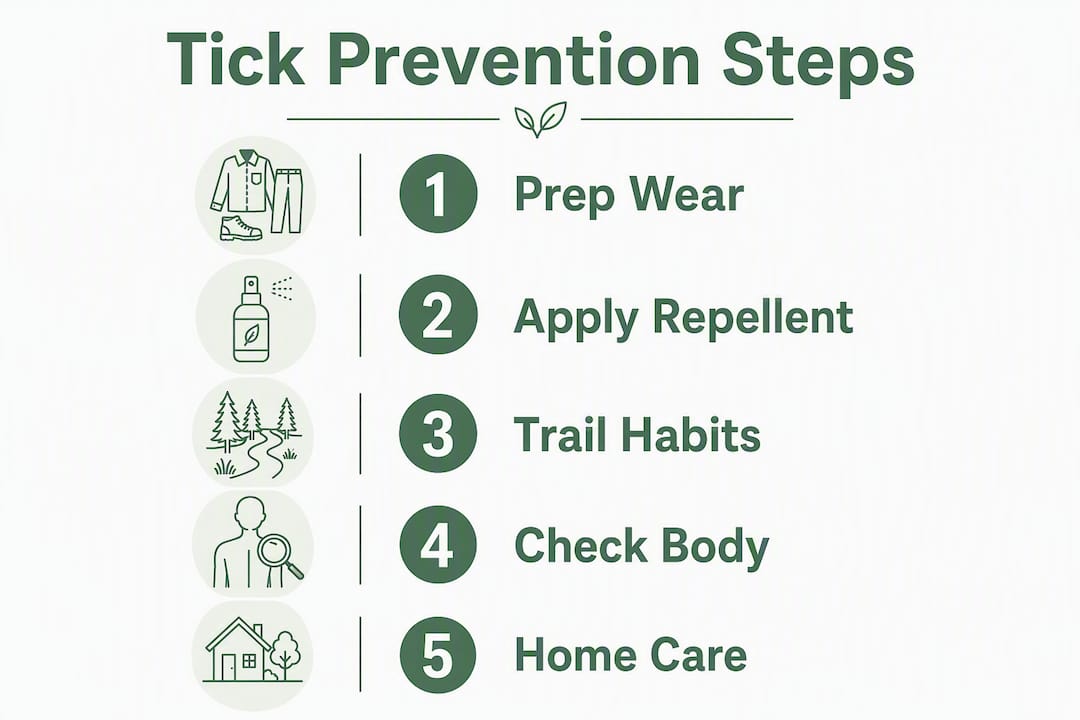
Wear the right layers. Long pants and long sleeves reduce exposed skin. Light colors make crawling ticks visible before they find skin. Tuck your pants into your socks to close the gap at the ankle, or use tick gaiters for heavier coverage. If you’re heading into dense brush or tall grass, consider hard rubber or high waterproof boots. Professional field staff from the Maryland DNR actually prefer rubber boots over tucked socks because the boot eliminates the fabric-to-fabric gap ticks exploit during the transition from ground to leg.
Treat your clothing with permethrin. Permethrin is an insecticide applied to fabric only, never to skin. CDC-backed data confirms that permethrin-treated clothing remains protective through several washings, so one treatment covers multiple trips. Apply it outside, let it dry completely before wearing, and keep treated items separate from untreated laundry. If you’d rather skip the chemical treatment entirely, the Bug Away Pants for men and Bug Away Pants for women use ultra-fine breathable mesh to create a physical barrier without any insecticide. More on that below.
Pack these items:
- Fine-tipped tweezers or a tick key for removal
- A lint roller (surprisingly effective at picking up crawling nymphs)
- Tick-repellent wipes for gear surfaces
- A small first-aid kit with antiseptic
- A sealed bag for used clothes at the end of the hike
Pro Tip: Pack a spare set of clothes in a sealed zip-lock bag. At the trailhead, swap into your hiking clothes and seal the clean set. After the hike, reverse it — your clean clothes stay tick-free for the drive home.
Which repellents actually work on ticks?
Not all insect repellents are created equal, and several popular products do nothing against ticks. The EPA’s registered repellent list is the fastest way to verify a product’s effectiveness. Look for an EPA Reg. No. on the label — that number means the manufacturer submitted effectiveness data to the agency.
The active ingredients with solid evidence for tick repellency:
- DEET: — The most studied option. Effective on ticks and mosquitoes. Safe for adults and children over 2 months per EPA guidance; avoid applying to children’s hands, eyes, or mouth.
A few practical rules: apply sunscreen first, then repellent. Reapply after heavy sweating or swimming. Spray repellent on clothing as well as skin for better coverage. For permethrin clothing safety details, including wash-separation guidance and precautions for pregnant hikers, that resource covers the specifics.
| Active Ingredient | Effectiveness on Ticks | Typical Duration | Key Safety Note |
|---|---|---|---|
| DEET (20–30%) | High | 4 hours | Avoid on children under 2 months |
| Picaridin (20%) | High | 8 hours | Safe for most ages; check label |
| IR3535 (20%) | Moderate–High | 4 hours | Low irritation profile |
| OLE/PMD | Moderate–High | 4 hours | Not for children under 3 |
| Permethrin (clothing) | High (fabric only) | Multiple washings | Never apply to skin |
How do you reduce tick contact while on the trail?
Trail behavior is where a lot of hikers lose ground they gained with good clothing prep. A few habits make a real difference.
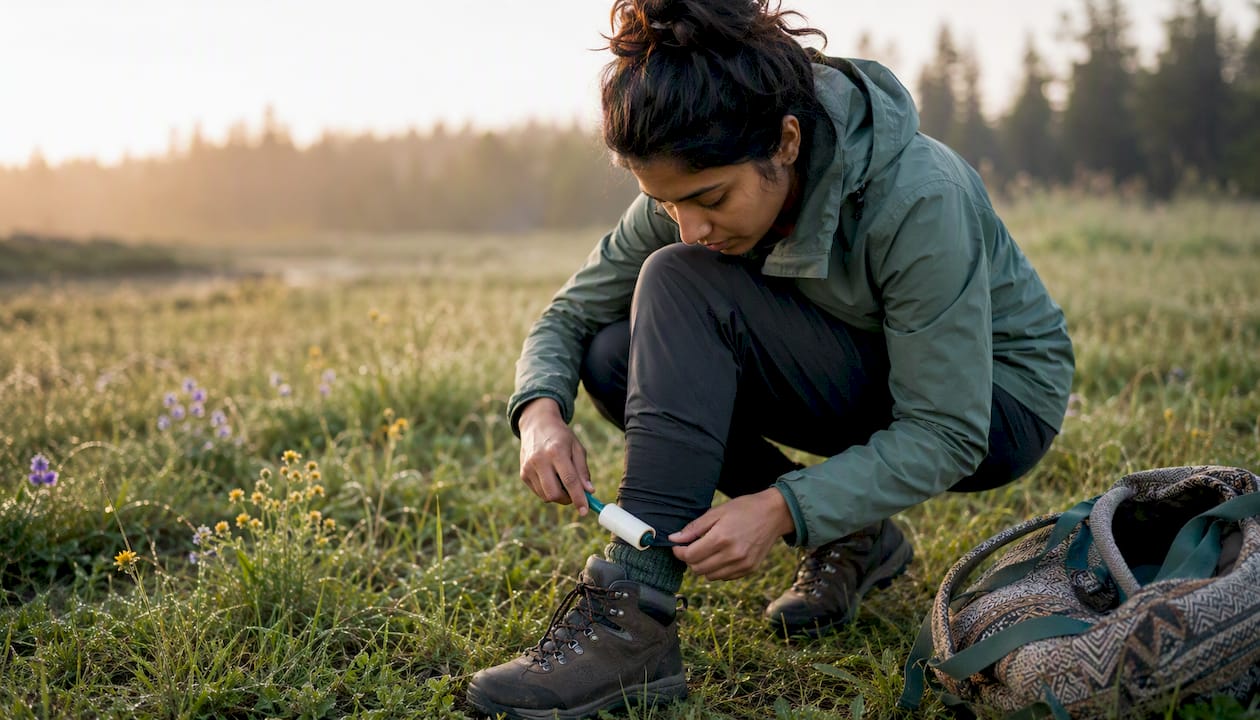
Stay in the center of clearly defined trails and avoid brushing against vegetation on either side. Ticks “quest” by climbing to the tip of a grass blade or leaf and holding their front legs out, waiting to grab onto whatever passes. The trail edge is their hunting ground. Walk the middle and you skip most of that contact.
Avoid sitting on logs, stumps, or bare ground during breaks. Use your pack as a seat, or bring a small foam pad. If you do sit on a log, check your clothing before you stand up.
Check your clothing and exposed skin at every major break — mid-morning, lunch, mid-afternoon. Ticks crawl for a while before they attach, so catching them during a break is entirely realistic. Run a lint roller over your lower legs and waistband. Use a hand mirror or ask a trail partner to check the back of your legs and neck.
Pro Tip: Nymphal ticks are the size of a poppy seed and nearly translucent. A lint roller picks them up far more reliably than a visual scan alone. Keep one clipped to the outside of your pack.
What should you do as soon as you get home?
The post-hike routine is where most people cut corners, and it’s one of the highest-leverage moments in tick prevention.
Shower within two hours. CDC guidance is direct on this: showering soon after coming indoors reduces Lyme disease risk and gives you the chance to wash off unattached ticks before they find a spot to bite. A warm shower also makes a full-body check easier.
Do a full-body check. Pay close attention to:
- Behind the knees and in the groin
- Under the arms and around the waist
- In and around the ears
- The scalp and hairline (especially in children)
- Behind the neck
Handle your clothes correctly. Bag used hiking clothes immediately and keep them away from furniture and pets. Then run them through the dryer on high heat for at least 10 minutes before or after washing. Experts note that ticks depend on moisture to survive, and a hot dryer cycle kills them through desiccation more reliably than a standard wash cycle alone.
Statistic callout: CDC guidance confirms that showering within two hours of coming indoors reduces Lyme disease risk and improves the chance of finding unattached ticks before they bite.
How do you find and safely remove an attached tick?
Speed matters here. The sooner you remove an attached tick, the lower your risk of disease transmission.
Where to check: Adults should focus on the lower body first — ankles, calves, backs of knees, groin — then work upward. In children, check the head and neck carefully, including behind the ears and along the hairline.
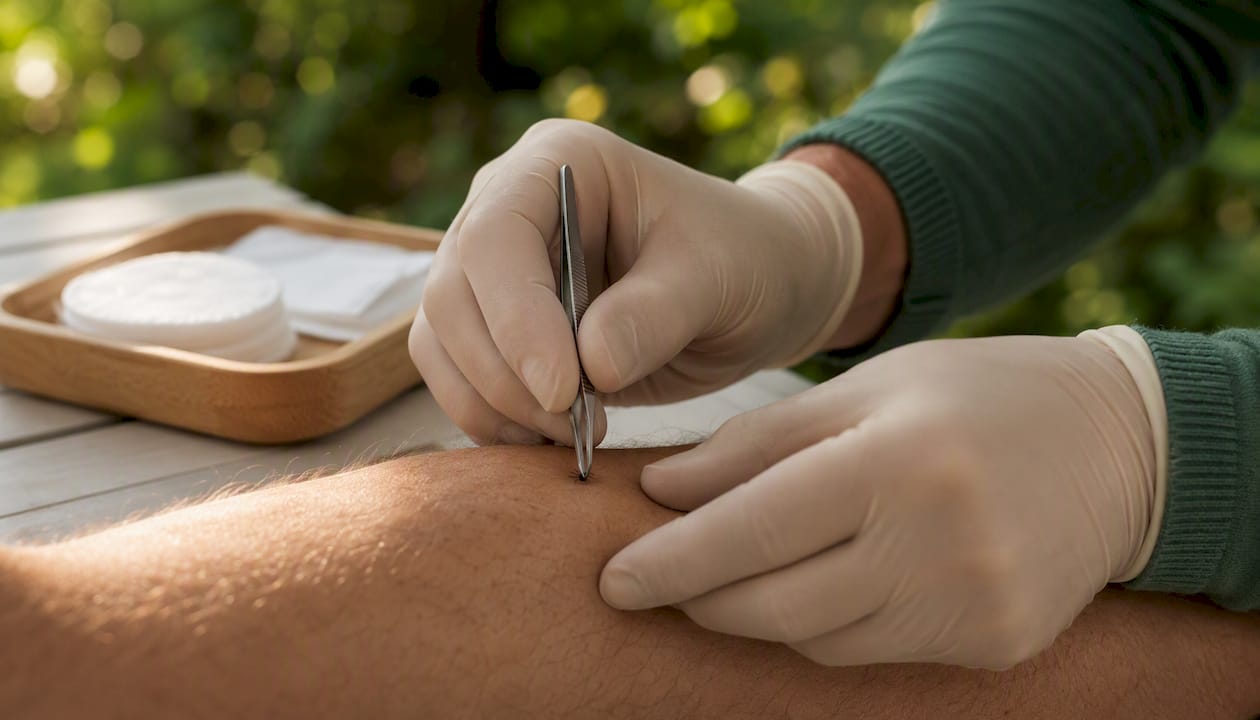
Tools to use: Fine-tipped tweezers are the standard. A tick key or similar approved removal tool also works well. Avoid using your fingers alone.
Removal steps:
- Grasp the tick as close to the skin surface as possible.
- Pull upward with steady, even pressure. Do not twist or jerk.
- Clean the bite site with rubbing alcohol or soap and water.
- Dispose of the tick by placing it in alcohol, sealing it in a bag, or flushing it. If your local public health department recommends tick testing, save it in a sealed container with a damp paper towel.
Do not use:
- Petroleum jelly or Vaseline
- Heat from a match or lighter
- Nail polish or nail polish remover
These methods cause the tick to regurgitate, which can increase disease transmission risk.
Pro Tip: If you’re unsure how long the tick was attached, note the date and take a photo of the bite site. That information helps a clinician assess your risk and decide whether prophylactic treatment is appropriate.
When should you see a doctor after a tick bite?
Most tick bites don’t lead to illness, but some do, and the window for effective treatment is narrow.
Lyme disease transmission from Borrelia burgdorferi is most likely after a tick has been attached for roughly 24–36 hours. That’s why early removal is so important. A tick you find and remove within a few hours of attachment carries a much lower transmission risk than one that’s been feeding overnight.
Seek medical attention if you notice:
- An expanding red rash (erythema migrans), often described as a bull’s-eye pattern, appearing days to weeks after a bite
- Fever, chills, or flu-like symptoms within a few weeks of a hike
- Facial palsy or drooping
- Severe joint pain or swelling
- Neurological symptoms like numbness, tingling, or difficulty concentrating
CDC guidance outlines criteria under which a clinician may discuss prophylactic antibiotics — typically a single dose of doxycycline within 72 hours of removing a deer tick that was attached for 36 or more hours in a high-risk area. That decision belongs to a clinician, not a checklist. Contact your local public health department or state DNR for guidance on tick species and disease prevalence in your area.
Note: This article provides general information, not medical advice. Confirm current treatment guidelines with a qualified healthcare provider.
How do you keep ticks out of your home and vehicle?
Ticks that hitch a ride home on your gear or clothing can survive indoors long enough to find a host. A few simple steps close that gap.
- Store used hiking clothes in a sealed bag until you can run them through the dryer. Never drop them on the floor or couch.
- Keep permethrin-treated clothing separate from untreated laundry to avoid cross-contamination.
- Wipe down boots, trekking poles, and pack surfaces before bringing them inside. A tick-repellent wipe or damp cloth works for hard surfaces.
- In your vehicle, place used gear in the trunk or a sealed bag. Check seat covers and floor mats if you’ve been in heavy tick country.
- At home, reduce tick habitat near the property edge: clear leaf litter, keep grass mowed short, and consider a wood-chip or gravel barrier between lawn and wooded areas.
These aren’t dramatic measures. They’re five-minute habits that stop ticks from turning a day hike into a week-long problem.
What the evidence says, and what most hikers get wrong
The single most persistent myth about ticks is that they drop from trees. They don’t. Harvard Lyme researchers confirm that ticks are low-vegetation questers — they climb to the tips of grass blades and leaves and wait. They never fall from above. That one misconception leads hikers to focus on their shoulders and head when the real risk is at ankle and knee height.
This changes the prevention calculus. Lower-body protection — tucked pants, gaiters, treated socks, or a physical-barrier pant — matters more than a hat. The Maryland DNR field staff who work in tick-dense environments daily prioritize rubber boots and center-trail walking over almost anything else.
The evidence on post-hike habits is equally clear. A hot dryer cycle kills ticks through desiccation. A standard warm wash may not. Showering within two hours improves your odds of finding unattached ticks before they bite. These aren’t suggestions — they’re the steps that actually move the needle.
For hikers who prefer to skip chemical treatments entirely, chemical-free mesh clothing works as a physical barrier. The Bug Away Pants for men and women use ultra-fine breathable mesh with integrated foot coverage, which addresses the ankle-to-knee zone where most tick attachment happens. No permethrin reapplication, no skin contact with insecticides.
Pro Tip: Run a lint roller over your lower legs and waistband the moment you reach the trailhead parking lot, before you get in the car. That two-minute habit catches crawling ticks before they find skin or fabric gaps.
Callout: Ticks quest on low vegetation, not from trees — which means lower-body protection (tucked pants, gaiters, or mesh barrier clothing) is the single highest-leverage clothing decision you can make.
Key Takeaways
Consistent hiking tick prevention comes down to three layers: what you wear before you go, how you behave on the trail, and the post-hike routine you stick to every single time.
| Point | Details |
|---|---|
| Prep your clothing | Tuck pants into socks, treat with permethrin, or wear physical-barrier mesh pants before every hike. |
| Use EPA-registered repellent | Apply DEET, picaridin, or IR3535 to exposed skin; reapply after heavy sweating. |
| Walk center-trail and check often | Stay off vegetation edges and run a lint roller over lower legs at every major break. |
| Shower within two hours of coming indoors and dry clothes on high heat | CDC guidance links this routine to reduced Lyme risk; high-heat dryer for 10+ minutes kills ticks. |
| Bugawaygear physical-barrier option | Bug Away Pants (men’s and women’s) use ultra-fine mesh to block ticks without any chemical treatment. |
The habit most hikers skip
There’s a gap between knowing what to do and actually doing it after a long day on the trail. The shower-and-clothes-swap routine is the one that most hikers skip, not because they don’t know about it, but because they’re tired and it feels like one more thing.
The fix is to make it part of trip closure, the same way you lock the car or put your keys away. You get home, you strip at the door, clothes go in a sealed bag or straight to the dryer, you shower. That sequence takes maybe 15 minutes and it’s the single highest-impact thing you can do after the clothing and repellent prep you did before the hike.
Frequent hikers who build injury-prevention and outdoor performance habits into their routine tend to apply the same logic here: the habit only works if it’s automatic. Tie it to something you already do at the end of every outing and it stops feeling like effort.
The other thing worth saying: no single method is foolproof. Permethrin-treated clothing is excellent but requires reapplication. DEET works but needs reapplication after sweat. Physical-barrier clothing covers the legs but not the face or arms. The hikers who stay bite-free consistently are the ones layering two or three of these approaches, not betting everything on one.
Zero-chemical tick protection that actually fits your hike
If you’ve been relying on permethrin spray and a mental note to reapply, there’s a cleaner option. Bugawaygear’s Bug Away Pants are built from ultra-fine breathable mesh that physically blocks ticks at the lower body — the zone where most attachment happens — without any insecticide on your skin or fabric.
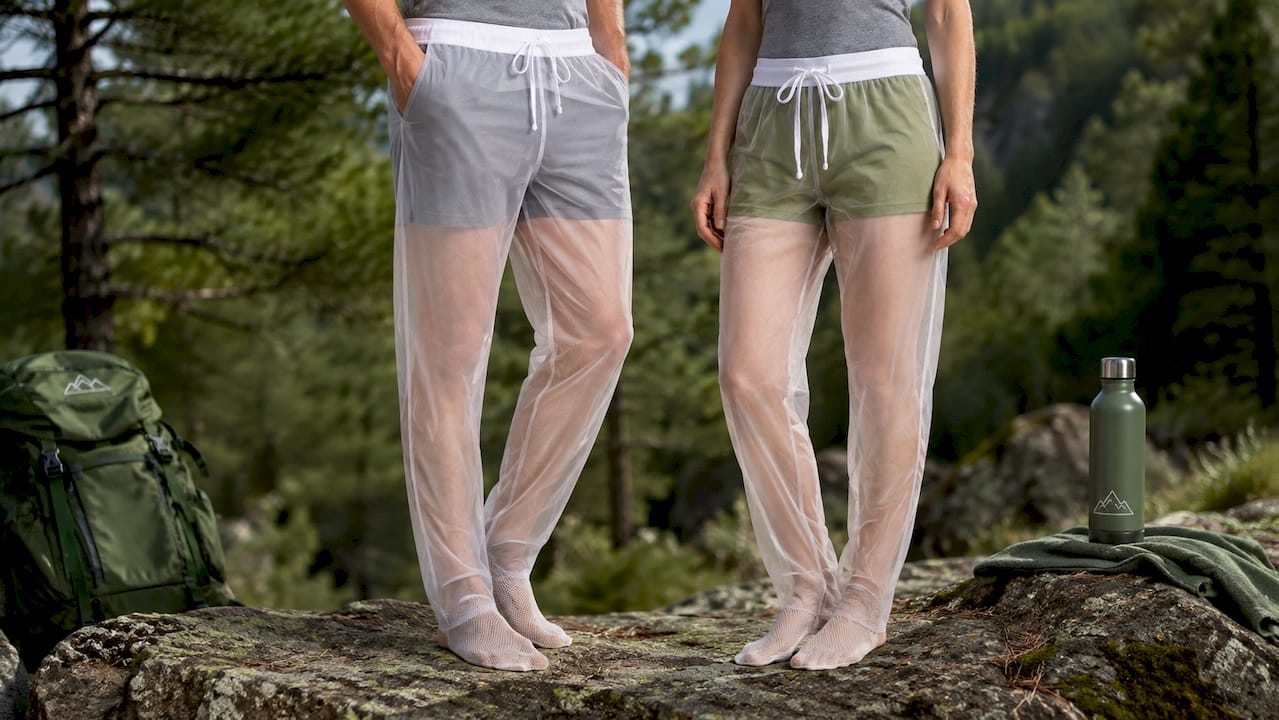
The men’s and women’s versions both feature integrated foot coverage, which closes the ankle gap that ticks exploit when climbing from boot to pant. The fabric is lightweight enough for warm-weather hiking and eco-responsible by design. Over 500 customers report zero tick bites while wearing them, and every order comes with a 30-day money-back guarantee.
If you want to cut the chemical reapplication cycle and still have solid lower-body protection on every hike, the Bug Away Pants for men and Bug Away Pants for women are worth a look. See the full hiking gear range at Bugawaygear to find the right fit for your next trail.
Useful sources
The sources below are the most authoritative references used in this article. For local tick species, disease prevalence, and treatment decisions, contact your state or county public health department directly.
| Source | What it covers |
|---|---|
| Preventing Tick Bites — CDC | Repellent guidance, shower timing, permethrin use, and full-body check recommendations |
| Tick-Borne Diseases and Prevention — Appalachian Trail Conservancy | Lyme transmission timeline and trail-specific prevention for long-distance hikers |
| Preventing Tick Bites — Harvard Lyme Initiative | Tick biology, questing behavior, and myth-busting |
| Preventing Tick Bites Like the Pros — Maryland DNR | Field-staff habits, lint roller use, boot selection, and center-trail walking |
| How to Avoid Tick Bites — The Conversation | Dryer heat science, yard measures, and chemical-free alternatives |
| EPA Insect Repellent Finder | Search tool for EPA-registered repellents by active ingredient and use case |
| Tick Bite Prevention — Wisconsin DHS | State-level guidance on seasonal activity, personal protection, and yard management |